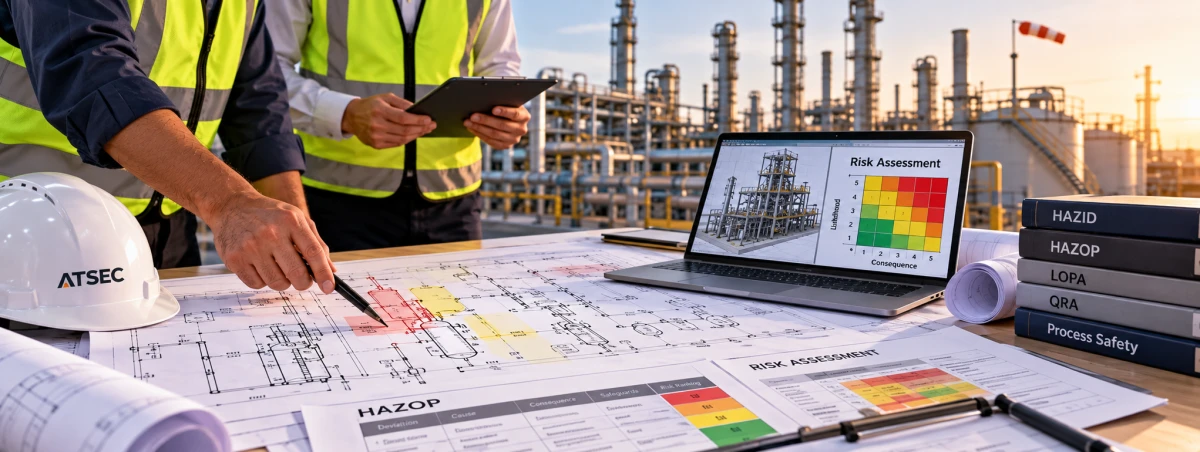
Process Hazard and Risk Assessment
We provide process hazard and risk assessment services, including hazard identification, HAZOP studies, layers of protection analysis (LOPA), and quantitative risk assessment (QRA).
Process Hazard and Risk Assessment
Risk assessment is an important part of safety planning for industrial facilities and projects involving processes, equipment, and operations that may present safety hazards. A structured assessment helps identify potential hazards, analyze credible scenarios, and provide engineering information to support safety-related decisions.
Advanced Technology Solutions Engineering Consultancy (ATSEC) offers process hazard and risk assessment services, including Hazard Identification (HAZID), Hazard and Operability Studies (HAZOP), Layers of Protection Analysis (LOPA), Safety Integrity Level (SIL) determination, Quantitative Risk Assessment (QRA), and consequence modeling, according to facility characteristics, project scope, and technical requirements.
Why Is Process Risk Assessment Important?
Process risk assessment helps organizations understand hazards associated with facility activities, equipment, and operating systems. This includes identifying potential sources of harm, examining possible causes of incidents, analyzing their consequences, and evaluating the safeguards available.
Risk study findings support engineering decision-making and help identify issues that may require further investigation or additional risk-reduction measures, in accordance with project requirements and applicable standards.
Our Risk Assessment and Analysis Services
1. Hazard Identification (HAZID)
Hazard Identification (HAZID) studies are used to identify potential hazards associated with a facility, project, or operational activity.
These studies help organize and document identified hazards and discuss their potential effects, providing an initial basis for risk evaluation and identifying topics that may require more detailed analysis.
2. Hazard and Operability Studies (HAZOP)
Hazard and Operability Studies (HAZOP) examine potential deviations from the intended operating conditions of a process and evaluate their causes, consequences, and associated safeguards.
The study supports structured technical discussions among relevant disciplines and documents findings and recommendations within the agreed scope.
3. Layers of Protection Analysis (LOPA)
Layers of Protection Analysis (LOPA) is used to evaluate the adequacy of independent protection layers associated with a defined risk scenario, based on the methodology and data adopted for the study.
The analysis helps organize the relationship between hazardous scenarios, their causes, potential consequences, and available safeguards, supporting decisions about risk reduction where required.
4. Safety Integrity Level (SIL) Determination
Safety Integrity Level (SIL) determination addresses the required performance of safety instrumented functions associated with specific hazards.
The required level depends on the risk analysis, the methodology applied, project requirements, and relevant standards. Technical findings are documented according to the study scope and available data.
5. Quantitative Risk Assessment (QRA)
Quantitative Risk Assessment (QRA) uses quantitative methods to analyze risk, including the estimation of scenario likelihoods and consequences based on defined data and assumptions.
Assessment results can help clarify risk levels, compare different scenarios, and provide engineering information to support the evaluation of risk management options within the project scope.
6. Consequence Modeling
Consequence modeling evaluates the potential effects of hazardous scenarios using analytical models and methods appropriate to the case and available data.
Depending on the study scope, the analysis may address potential effects of fires, explosions, or hazardous substance releases. The findings help explain the possible impact of incidents and support the assessment of relevant safety considerations.
Our Risk Assessment Approach
Risk assessment methods vary according to facility type, process characteristics, available data, and study objectives. A typical assessment may involve defining the scope, collecting technical information, identifying relevant hazards and scenarios, analyzing causes and consequences, evaluating safeguards, and documenting findings and recommendations.
The appropriate methodology and deliverables are determined according to the project characteristics and applicable technical and regulatory requirements.
Supporting Engineering Decisions and Risk Management
Risk assessment studies provide information that helps engineering teams and stakeholders understand potential hazards and prioritize risk-related issues. Findings may also support design reviews, safeguard evaluations, and discussions about appropriate risk-reduction measures.
The use of study results depends on the defined scope, underlying assumptions, available data, and the specific requirements of the facility and project.
Risk Assessment Tailored to Facility Requirements
Hazards and assessment requirements vary across industrial facilities, projects, and processes. The scope and level of analysis are therefore defined according to the activity, scenarios under consideration, available technical information, and applicable requirements.
Depending on the agreed scope, services may include HAZID and HAZOP studies, LOPA, SIL determination, QRA, and consequence modeling.
Engineering Consultancy for Process Hazard and Risk Assessment
ATSEC provides engineering consultancy services for process hazard and risk assessment, focusing on structured technical studies, documented findings, and information that supports risk reviews and engineering decisions.
If your project requires hazard identification, incident scenario analysis, or evaluation of protection measures, contact ATSEC to discuss the appropriate study scope and required deliverables.
ATSEC — Engineering solutions that support safety and design quality.
- Hazard Identification (HAZID)
- Hazard and Operability Studies (HAZOP)
- Layers of Protection Analysis (LOPA)
- Safety Integrity Level (SIL) Determination
- Quantitative Risk Assessment (QRA)
- Consequence Modeling